Your AI Stack Has a Half-Life: 5 Ways to Keep It Current
A maturity framework for absorbing AI change without continuous re-platforming
By Ranjan Goel, October 6, 2026
For most enterprise technology leaders, the question is no longer whether to adopt AI. It is how to build an AI platform that will not be obsolete six months after deployment.
The pace of change here is different from traditional enterprise software. Models improve every week. Agent frameworks emerge and disappear. Context windows expand. Costs fall, and sometimes rise. Security threats appear. So do new state and country-level regulations and industry guidance.
An AI architecture selected today may still work two years from now. That is no guarantee it will still be competitive, economical, or secure.
For CTOs, this creates a new technology-management problem:
How do you capture the benefits of rapid AI innovation without forcing the enterprise into continuous re-platforming?
Chasing every new model is not a strategy. What works is building an organization and an architecture that can absorb change safely.
The AI Stack Maturity Framework
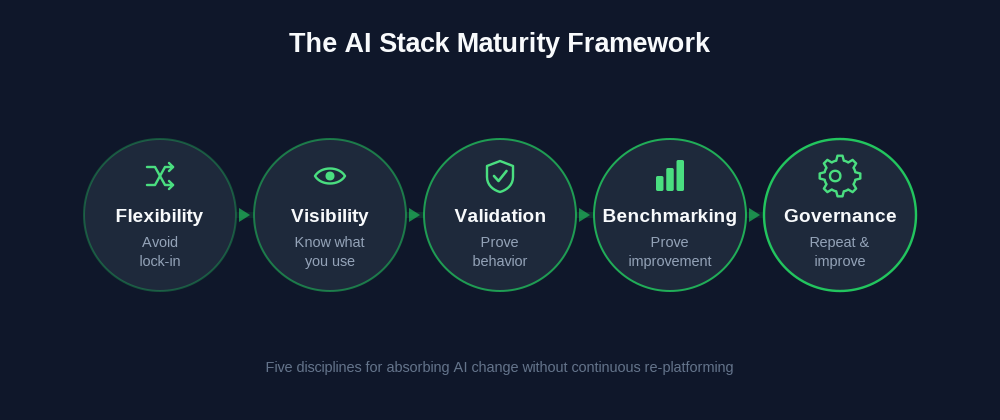
Five disciplines help organizations keep an AI stack current without turning every model release into an engineering fire drill.
1. Architect for Flexibility, Not Today's Best Model
The AI market moves too quickly to assume that today's preferred model, framework, vector database, guardrail, or agent runtime will still be the best option in six months.
Enterprise architecture should optimize for flexibility:
- Separate business logic from model-specific logic.
- Standardize interfaces between applications, models, tools, retrieval systems, security controls, and observability layers.
- Make it possible to evaluate another model without redesigning the application.
If a materially better model appeared tomorrow, how difficult would it be to evaluate and adopt it?
If the answer is six months of reengineering, that is more than technical debt. It is strategic dependency risk.
2. Know What's Actually Inside Your AI Stack
Most CIOs can produce a reasonable inventory of servers, cloud services, endpoints, and software assets.
Ask the same organization which models, prompts, agents, datasets, vector databases, MCP servers, third-party tools, and AI libraries are running across production applications, and the answer tends to be less clear.
That visibility gap is an enterprise risk. Consider what happens when a model is deprecated, an open-source package carries a critical vulnerability, an external agent tool is compromised, or a new security advisory lands. The first executive question will be:
Are we impacted?
Without an inventory, answering can take days.
Enterprises need an AI equivalent of the software bill of materials, usually called an AI Bill of Materials, or AIBOM. The point is impact analysis rather than inventory for its own sake.
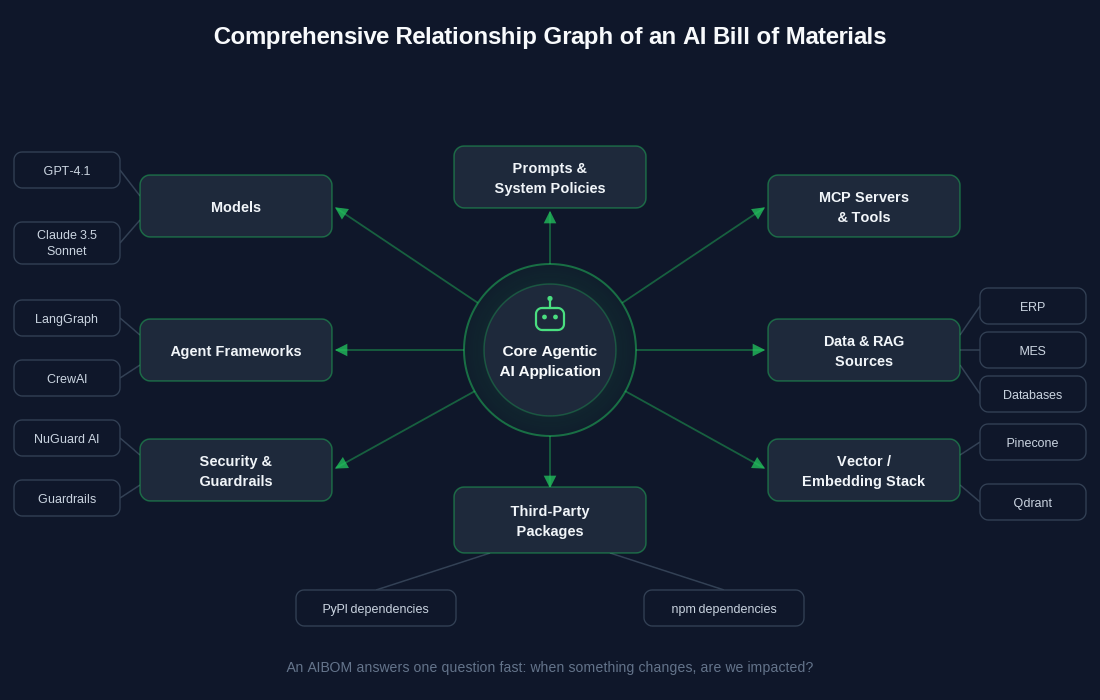
Once one exists, a CTO or CISO can answer three questions:
- What are we running?
- Where is it running?
- What business processes and data does it touch?
That is the foundation for everything that follows.
3. Revalidate AI Behavior Every Time the Stack Changes
Traditional regression testing asks whether the application still works. AI systems add a second question: does the application still behave the way we intended?
Changing a model may improve reasoning while changing refusal behavior. Updating a system prompt may improve usability while weakening safeguards. Adding a tool may improve an agent's capabilities while enlarging its attack surface.
Change management for AI systems therefore has to include behavioral validation. Before approving a material change, validate three things:
| Executive concern | What to validate |
|---|---|
| Business performance | Does the AI still complete its intended tasks accurately and effectively? |
| Quality and economics | Are quality, latency, throughput, and inference cost within acceptable thresholds? |
| Security and safety | Can it be manipulated into violating policy, leaking sensitive data, or misusing integrated tools? |
This matters more as enterprises move from copilots that recommend actions to agents that take them. The OWASP Top 10 for Agentic Applications addresses exactly the risks created by autonomous systems that plan, use tools, interact with other agents, and carry out workflows.
A technology change should earn trust through validation.
4. Benchmark Before You Upgrade
The AI market creates enormous pressure to upgrade. A new frontier model launches. A vendor announces dramatically better benchmark results. An open-source model closes in on proprietary performance. An agent framework becomes popular almost overnight.
The natural reaction is to ask whether you should upgrade. But newer and better are not the same thing.
Enterprise AI should shift from release-driven upgrades to evidence-driven ones. Before replacing a model or any other critical component, compare the candidate against a representative set of your own workloads.
The AI Stack Upgrade Scorecard
| Evaluation metric | Current stack | Candidate stack |
|---|---|---|
| Quality | ●●●○ Good | ●●●● Excellent |
| Task success | ●●●○ Moderate | ●●●● High |
| Security | ●●●● Verified | ●●●○ Needs audit |
| Latency | ●●●○ ~1.2s | ●●●● ~0.6s |
| Reliability | ●●●● 99.9% uptime | ●●●○ Unproven |
| Cost | ●●○○ Higher | ●●●● Efficient |
| Decision | Keep (baseline) | Investigate further |
The exact scoring methodology matters less than the discipline of asking:
What measurable business benefit are we receiving in exchange for introducing change?
5. Turn the Framework into an Operating Discipline
The last challenge is organizational rather than technical.
Most enterprises already have structured processes for vulnerability management, architecture review, cloud cost optimization, patching, and software lifecycle management. AI needs a similar operating model. That does not call for another heavyweight governance committee, only clear ownership and a predictable review cycle.
A Simple Executive AI Stack Dashboard
| Dimension | Healthy | Warning | Critical |
|---|---|---|---|
| Technology | Current and supported | Better alternatives emerging | Deprecated or unsupported |
| Security | Validated and safe | New risks identified | Critical exposure |
| Performance | Meets targets | Declining relative performance | Business SLA failure |
| Economics | Competitive | Optimization opportunity | Material cost disadvantage |
| Governance | Within policy | Review needed | Outside approved controls |
A quarterly review of this dashboard is likely more useful to an executive team than reviewing dozens of individual technology releases. The aim is knowing where change matters, not running the newest stack. Your governance model needs to evolve alongside your technology.
Building AI Technology Resilience
Organizations that treat AI stack refreshes as a sprint run out of breath within months. A framework aligns the cross-functional stakeholders involved, from AI developers to QA, DevOps, and InfoSec and AppSec teams.
What a maturity framework produces is worth considerably more than access to the latest model. It produces AI technology resilience.
Frequently asked questions
What is an AI Bill of Materials (AIBOM)?
An AIBOM is the AI equivalent of a software bill of materials. It inventories every model, prompt, agent, dataset, vector database, MCP server, third-party tool and AI library running across production applications. Its purpose is impact analysis: when a model is deprecated or a vulnerability is disclosed, it answers whether you are affected in minutes rather than days.
How often should an enterprise review its AI stack?
A quarterly review against a fixed set of dimensions (technology, security, performance, economics and governance) is generally more useful to an executive team than tracking individual model releases. The aim is knowing where change matters, not running the newest stack.
What should you validate before upgrading an AI model?
Validate three things against your own workloads rather than published benchmarks. Business performance, whether the system still completes its intended tasks accurately. Quality and economics, whether latency, throughput and inference cost remain within threshold. Security and safety, whether the system can be manipulated into violating policy, leaking data or misusing its tools.
Why does changing an AI model require behavioral testing?
Traditional regression testing asks whether the application still works. An AI system can keep working while behaving differently. Changing a model may improve reasoning while altering refusal behavior, a new system prompt may improve usability while weakening safeguards, and adding a tool may expand an agent's capabilities along with its attack surface.
How do you avoid vendor lock-in with AI models?
Separate business logic from model-specific logic, standardize the interfaces between applications, models, tools, retrieval systems and security controls, and make it possible to evaluate an alternative model without redesigning the application. The test is simple: if a materially better model appeared tomorrow, how long would adopting it take?
Related Articles
Behavior Matters
A system can return the right answer and still behave in the wrong way. Learn why behavioral evaluation — tracking decision paths, tool usage, and execution traces — is the new standard for enterprise AI agent validation.
What Is an AI-SBOM?
An AI-SBOM is a structured inventory of everything an AI agent can do, access, and affect. Learn why traditional SBOMs fail for agentic AI, what the 8 node types contain, and how to generate one.